transient weak gravitational shielding
Demonstration of transient weak gravitational shielding by a YBCO LEVHEX at the superconducting transition.
by John Schnurer
The Gravity Society
Post Office Box CN 652
Yellow Springs, Ohio
45387 USA
From: www.gravity.org
We have recently succeeded in partially reproducing the weak gravitational shielding effect described by Podkletnov. Our experimental setup was designed to eliminate, as far as is possible, any non-gravitational disturbance, and to show a precise temporal correspondence between actions taken on the HTC disk and the weight reduction of the sample/proof mass. Although the observed weight reduction was large enough to be clearly distinguished from the noise (of the order of 1 % or more), it was detected only in transient form, lasting up to ca. 3 s. This happened because the weight reduction was coincident with the superconducting transition of the HTC disk, which occurred quite rapidly when the disk warmed up over its critical temperature.
Our earlier experimental setup is described in the Appendix of the old version of report gr-qc/9612022. An improved setup allowed us to run more than 400 trials with an heavier proof mass (a glass rods bundle - total weight 63 g), accumulating better statistics. Approximately 10 % of the trials gave positive result, i.e., a clear transient reduction in the weight of the proof mass. This apparently random behavior signals that some of the conditions which are necessary to trigger the effect are not well under control yet. In particular, we found that the duration of the superconducting transition is crucial: if the transition is too quick or too slow with respect to certain criteria, no effect is observed. The duration of the transition, in turn, depends strongly on the thermal conditions of the disk, and the latter can be controlled only with limited accuracy.
Our improved setup did not comprise the AC generator anymore. Thus error analysis is further simplified. One only needs to consider the parasitic effects of buoyancy and molecular diamagnetism. For both error sources, upper limits can be set according to the discussion by Podkletnov and these limits are much smaller (by a factor 20 at least) than the observed effect.
As mentioned above, the transient reduction in the weight of the proof mass was always coincident with the thermal transition of the YBCO disk from the superconducting to the non-superconducting state. This was checked as follows.
- A dewar flask with an inside diameter of about 3 cm and
14 cm deep allows to observe the experiment from the side
by virtue of the fact that about 2.5 cm of the silvering,
inside and out, has been removed when manufactured (see Fig.
1 (http://www.gravity.org/dew.htm)). The top of a hollow cylinder of polyethylene is flush
with the bottom of the removed silvering. This cylinder supports,
through two parallel bamboo sticks, a 2.5 cm by 1.3 cm,
0.3 cm thick samarium cobalt permanent magnet with an MGOe
factor of approximately 18. The magnet is even with the bottom
of the removed silvering.
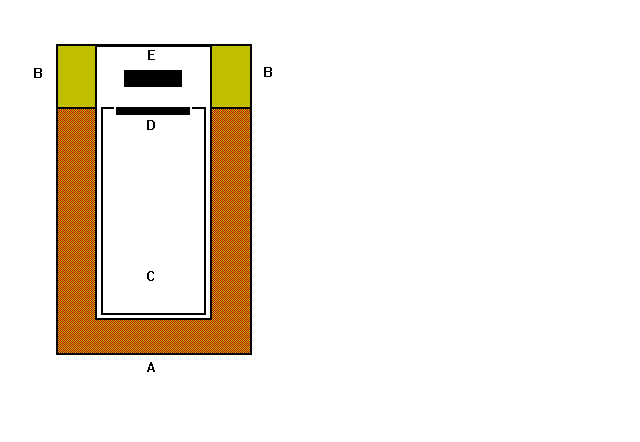 Figure 1. (http://www.gravity.org/dew.htm)
 Fig. 1 - Scheme of our [magnet+LEVHEX] setup.
- The dewar contains liquid nitrogen, as to half fill the clear observation area. This leaves about 1.3 cm of empty dewar with the permanent magnet at the bottom. After filling, all is allowed to cool down. A LEVHEX, almost-single-crystal, "pinning type" YBCO hexagon (2.0 cm from side to side) is tied to a cotton string and lowered into a second dewar to cool. When the LEVHEX is chilled, it is lowered into the first dewar. The levitation effect is pronounced and a piece of bamboo is used to push the hexagon down and leave it at approximately 0.6 cm above the magnet, as opposed to ca. 2.0 cm of its highest equilibrium position. The hexagon is well pinned and the familiar "tied to little springs" effect is well in evidence.
- The detection system (Fig.
2 (http://www.gravity.org/bil.htm)) is quite similar in principle to that used in previous
work. Namely, a 33 cm by 51 cm glass plate on ring
stand clamps is interposed between the dewar and a 63 g
proof mass made of a hexagonal bundle of 7 rods, each 10 cm
long and 0.6 cm in diameter. The string is tied to a dry
1 cm by 1 cm, 200 cm long wooden beam. The
beam acts as a balance and has a 3 mm hole drilled in the
middle. A 1 mm stainless steel pin in an aluminum stirrup
serves as a pivot in the middle. The purpose of the beam is to
place a "Mettler 300" scale (300 g full scale,
0.01 g resolution) at least 180 cm from the dewar.
The proof mass is directly over the levitating hexagon and the
far end of the beam has an excess weight (aluminum blocks tied
by cotton string) which rests on the scale. Once the whole is
set up the scale is tared to leave a weight of 44.0 g.
In order to eliminate any electrostatic artifact, an aluminum
screen and a brass screen are taped to the glass plate placed
between the dewar and the proof mass.
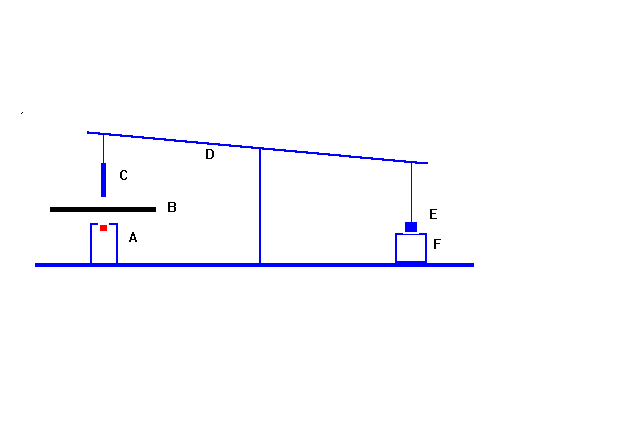 Figure 2. (http://www.gravity.org/bil.htm)
 Fig. 2 - Detection system for the demonstration experiment of transient shielding effect at the superconducting transition.
- As the liquid nitrogen boils away the temperature of the LEVHEX rises. We see this evidenced by a slight reduction in the height of levitation at first, and, finally, there is no levitation at all. Exactly during this phase, which may last typically between 5 and 10 s in the different runs, we observe a transient reduction in the weight of the proof mass as indicated by the counterweight on the balance. In a "positive" run the measurement on the scale generally goes from 44.0 to 46-47 g and then returns to baseline after 2-3 s. This corresponds to a reduction in the apparent weight of the proof mass.
- The application of AC magnetic fields may allow some control on the transition rate. The method described above, however, can be used to demonstrate the effect in a very clean way.


My Books