New Stars Offer Clue To The Past
New stars offer clue to the past
From: http://news.bbc.co.uk/2/hi/science/nature/6247001.stm
Jan 10, 2007
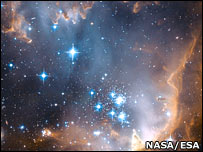
An image from the Hubble Space Telescope shows newly formed, bright, blue stars blowing a cavity in their "stellar nursery".
The region known as N90 might provide clues to star formation in the early Universe, say astronomers.
The nebula resides in a "primitive" dwarf galaxy thought to represent the building blocks of larger galaxies like our own.
The image was presented to the American Astronomical Society in Seattle.
N90 is situated in the Small Magellanic Cloud, in the constellation of Tucana, about 200,000 light-years away from the Earth.
Its primitive nature means it lacks a large percentage of the heavier elements forged in successive generations of stars through nuclear fusion, making it of great interest to astronomers.
The nebula's relative proximity to Earth gives astronomers the opportunity to use it as a laboratory for studying star formation in an environment close to that which existed in the early Universe.
The high energy radiation blazing out from the hot young stars in N90 is eroding the outer portions of the nebula from the inside.
Around the bright, blue stars is another population of newborn stars which have attracted attention from astronomers because they are still forming from gravitationally collapsing gas clouds.
The region allows astronomers to trace how the star formation started at the centre of the cluster and propagated outwards, with the youngest stars still forming today along the dust ridges.


My Books